Showing posts with label Zappa. Show all posts

Monday, March 08, 2021

Zappa (2020)

This documentary about Frank Zappa by director and writer Alex Winter offers up a pretty good biography, spreading its attentions evenly across most of Zappa's life, which ended in 1993 when he was 52. I learned some things I hadn't known—notably that he lived in New York City for a year or two in 1966 and 1967 and also about his assault on stage in 1971, which put him in a wheelchair for the better part of a year. But mainly it confirmed my sense that Zappa's best period was in the '60s with the original Mothers of Invention. I also appreciated the chance to put a face to Pamela Zarubica's Suzy Creamcheese voice which I know so well from Uncle Meat. The emphasis in Winter's documentary—and it's probably fair—is on Zappa's surly misanthropic perfectionist contrarian personality combined with a lifelong desire to be a composer and rigid dedication to his sense of integrity. Zappa is generally thought of as quintessential Iconoclastic Rock Star, and he was certainly that too—I still put him on the short list of best rock guitarists from the '60s and '70s, working the blues modes. But he considered himself a composer above all else, railed against the mainstream, directed even his rock bands like a conductor, and dreamed of an orchestra at his disposal, which could be adequately rehearsed before concert performance or recording studio. Along with the Velvet Underground, Zappa was an important figure in Soviet-sphere countries such as Czechoslovakia, where the Plastic People of the Universe (named for a song on Absolutely Free) sprang up in his wake. In the West, Zappa sponsored acts as diverse as the GTOs, Captain Beefheart, and Alice Cooper. He is the subject of Deep Purple's "Smoke on the Water." He was also a reasonably straight and square guy—married to the same woman for more than 25 years, with whom he had four children, though he philandered openly on the road. He divided much of his time between working at home in his recording studio, then escaping on the road for tours and the rock star lifestyle, and then escaping from that in turn to go back to the sanctity of his home again. I wish, as the '60s partisan, that the picture spent more time on that period but it wouldn't be fair to the rest of Zappa's career. He's still hard to like, too often the preening egotist for my taste, but certainly I feel for his desire to be a composer, which is about as futile as, say, writing poetry (or blogging, for that matter). It grated on him because, above all else, he was practical about supporting his family and, as he notes here bitterly several times, there is no money certain in composing. It is a cost center, not a profit center. It's sad that someone with so much talent got cancer and died so young—one of the few annoyances of this documentary is that it keeps noticing his cigarette smoking, when it was prostate and not lung cancer that he died of. Still, fair point: hey everybody, don't smoke, especially if you get cancer.

Monday, February 09, 2015

Frank Zappa, cont'd

(Requested by reader D.M.)

A couple years ago, Scott Woods over at rockcritics.com (and GreilMarcus.net, and elsewhere) started a series on Frank Zappa and at one point invited me to contribute. I suspect it's because he noticed I had a handful or more of posts on Zappa. Most of them came from the earliest days and another incarnation of this blog, when I was more or less attempting to orient and/or introduce myself in terms of taste via landmark albums. Zappa came up early because I encountered him early, as a 15-year-old in 1970, and he made quite an impact. The piece I came up with for Scott was a list of my favorites, all from the period 1966 to 1970, with some explanation. Some of these songs and albums I have returned to regularly all my life now, such as Uncle Meat. I also talked about my permanent point of departure in the early '70s, with the one-two(-three) combination of Fillmore East - June 1971 and 200 Motels (album and movie).

For this piece I decided to look on the other side of all that. The way I picked the four albums I landed on was highly scientific use of Google search engine ("best frank zappa albums"), going through the first page of results (one was a forum with many, many lists) and taking a raw tally by title. The vast majority—not surprisingly, I know, but still—came from the 1966-1970 period I already touched on. There was a fair amount of agreement on the full Joe's Garage (1979) but after that it was murky. Very little from the '80s and '90s seemed to have any kind of consensus of regard, if any regard at all. Out of the bulge of tepid support from the '70s I settled on Over-Nite Sensation (1973, for the good associations I had with "Montana"), Apostrophe (') (1974, though it contains the execrable "Don't Eat the Yellow Snow"), and Roxy & Elsewhere (1974, because I desperately hoped there might at least be some great live performances). I came close to looking into Waka/Jawaka (1972), Bongo Fury (1975, a collaboration with Captain Beefheart), and a few others, but decided to wait for further inspiration.

Wednesday, June 29, 2011

66. Mothers of Invention, "Who Are the Brain Police?" (1966)

(listen)

Here's one that's nod (if not outright shout-out) to my young high school self, although I hasten to say that it came along a few years before I was actually in high school. But the spooky paranoia and ham-handed production effects, with the obvious themes of big-brotherist issues, suited my point of view well at the time, one of those things I hoped I would always remember as a grown-up. I forget most of the rest now. It's from Zappa's auspicious debut with the Mothers of Invention, the double-LP Freak Out, which basically signaled all the elements that were to come of his entire career: the mordant wit, the humanist intellect, the compositional experimentation, the musical chops, and, of course, the belching and farting noises. And actually, if I'm going to be honest about it, I miss all the clichés and received wisdom on display here—"plastic" as perhaps the most devastating insult imaginable, deeply grounded resentment at corporate as well as government attempts to control intellectual honesty, and a willingness to let the vectors go erratic and the mix sloppy in emulation of vertical levels of chaos. I'm pretty sure the clichés and received wisdom of our current age are far more pernicious and feeble: the vapid tightness of cool, economic bootstrapping as viable strategy for improvement to character, material wealth as the unmistakable sign of God's grace, "government is the problem not the solution." You know what I'm talking about. Sometimes Frank Zappa's death in 1993 starts to look like Hunter Thompson's in 2005, a bad sign that times just got worse in ways we never could have imagined previously. But now I'm getting sentimental.

Friday, May 13, 2011

90. Frank Zappa, "Transylvania Boogie" (1970)

(listen)

There were a lot of guitar heroes cluttering up the joint in the late '60s and early '70s—Jimi Hendrix, Eric Clapton, Jimmy Page, Carlos Santana, Duane Allman, Jerry Garcia, etc., etc.—but I'm not sure Frank Zappa ever entirely got his due in this regard, probably because he was so much better known as sophisticated musical composer, rock savant, source of unbearable fart jokes, or most likely all of the above. The necessary evidence for all that is found on his best album, Hot Rats (minus the fart jokes, which as much as anything is the reason it's his best). But this five-minute workout, from his second solo effort (and one really not much different from other product released under the Mother of Inventions name), Chunga's Revenge, tends to be my single favorite track of all showcasing his guitar chops. It's got just about everything that made him a great player, including the ranges of tone he managed to draw, his fussy lyricism, his patience in the construction of a jam, and of course his facility with the wah-wah effect, perhaps his most signature element as guitarist. It's also got a strange and intriguing structure, with rhythms just slightly off-kilter, Aynsley Dunbar's drumkit pushed up in the mix and working the cymbals quite a bit, and Ian Underwood's spooky, nudging organ play that works like the current of a river, always nagging at you. "Transylvania Boogie" is not exactly something you can dance to, more like stand and bob your head or in concert hall situation sit and study dispassionately. Which might mean it lacks something in terms of guitar heroics, but in a way the clinical approach actually makes me like it even more, I think.

Tuesday, October 30, 2007

Chunga's Revenge (1970)

If not a hurry-up job to get something on the market, for whatever reason, this at least is some kind of transitional job. Resembling its predecessor Weasels Ripped My Flesh more than Frank Zappa's first official solo, Hot Rats, but neither so much like any of the Mothers albums from the '60s. Which is to say it's something of a pastiche but without much effort to tie the pieces together. So take it in the pieces offered: Zappa's fine guitar showcase on "Transylvania Boogie," the introduction of Flo & Eddie to the Mothers family, a brief nod to Zappa the nuanced composer on the brief "Twenty Small Cigars," the usual lame jokes about groupies and the rock 'n' roll life, snorts, belches, and hey, that's my old friend Peter getting one in off rhythm on the live section of "The Nancy and Mary Music," recorded at the Guthrie Theater in Minneapolis, Minnesota, with audience participation. Good going, Peter!

Friday, July 27, 2007

Weasels Ripped My Flesh (1970)

Perhaps best known for its cover art, in which Neon Park takes Roy Lichtenstein to the woodshed and then some, this one comes from the heart of Frank Zappa's pastiche-and-go period. Though arguably spotty, the memorable moments arrive fast and furious, whether it's Little Richard made bombastic by way of Sugarcane Harris's monster electric violin on "Directly From My Heart to You"; or one of Zappa's best and oft-used tunes here made into the sweetly sarcastic mockery of "Oh No"; or the lovely and beguiling wah-wah permutations of his guitar turn on "The Orange County Lumber Truck." The title song? Two minutes of blistering white noise. Sing along: "Rzzzzz!"

Sunday, January 28, 2007

Hot Rats (1969)

"The Gumbo Variations" In which Frank Zappa notably steps forward as owner and operator of an electric guitar (with wah-wah pedal). Or at least, that's the impression with which the longest tracks here would leave you, and that's fine. "The Gumbo Variations" choogles and chatters along in suitably funky fashion. Ditto "Willie the Pimp" and, in its quieter way, "Son of Mr. Green Genes." But don't miss the three lovely short tracks here: the small brilliant glories of "Peaches en Regalia"; the kinder, gentler choogle of "Little Umbrellas"; and the fluid deliberations of "It Must Be a Camel." Everything here is interesting and good to hear. Let's call it a classic.

buy from CD Universe

Burnt Weeny Sandwich (1970)

"The Little House I Used to Live In" Frank Zappa took his whole enterprise to another level with the sprawling Uncle Meat, but this follow-up, confined to the space of a single vinyl LP, produces a focus that seems to make practically everything glitter: the loopy, charming chamber suites as much as the rockin' proto-prog instrumental workouts. Ian Underwood's playing is fine, and so is violinist Sugarcane Harris's, and so is Zappa's -- and he's not afraid to cut unexpectedly between the live jams and his signature meld, perhaps here reaching its peak, of the sound of Raymond Scott and Igor Stravinsky tap-dancing on xylophones between the horse races. One of his best.

More information in comments.

buy from Amazon


Tuesday, September 19, 2006

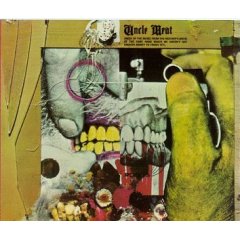
Uncle Meat (1969)

"Sleeping in a Jar" The big kahuna, more or less. Billed as soundtrack for a long-delayed movie I have never seen (I sat through 200 Motels, thank you), I think the real movie should have been a document of each moment of this album as its final versions were recorded and/or mixed. The cuts from live venues to studio bits and back again, the severe juxtaposition of musical styles, the multiple tracking – it's constant and seamless and often very beautiful. But a movie like that is no doubt difficult so we'll just have to make do with this very fine album.

buy from CD Universe

More Zappa on the Internets

Just noticed that there seems to be a spate of Zappa posts recently (via totally fuzzy):

9 boots (including Apocrypha, a 4-CD box) at Hipidetripi
Another boot at A Pound for a Brown (name likely from an Uncle Meat track, which makes this a good bet for checking back)
Overnite Sensation at RokanRoll

Adding
Lumpy Gravy & more, eventually the whole discography, at LinkWorld
Apocrypha also available at The Sky Moves Sideways

Monday, September 18, 2006

We're Only in it for the Money (1968)

"Flower Punk" There are those who will tell you this is the best album Frank Zappa ever made. I'm not so sure about that, but it's probably his funniest. Sending up the hippies ("my hair is getting good in the back"), bringing in Eric Clapton just to exclaim, "God, it's God, I see God!" (a joke that now requires too much explanation), the cover art literally turning Sgt. Pepper inside out (which anyone would have to admit was more effective in the big vinyl LP w/ gatefold package), and no less than nine songs clocking in under 2:00 (three of those under 1:00), this thing romps with no stops, holds, or limits. Concept with purpose. What an idea.

buy from CD Universe

Sunday, September 17, 2006

Absolutely Free (1967)

"Plastic People" More of the same and just as good, maybe even more so for being concentrated onto a single (vinyl) disc. It's worth noting that the legendary Plastic People, of the now Czech Republic, took their name from the Zappa song here. And while we're on the Czech Republic, I was amused and amazed when Vaclav Havel paid a visit to the Clinton White House in 1998 and made a special request of meeting Lou Reed. Reed may even have performed for Clinton and Havel, I can't remember. By then Zappa was nearly five years dead from cancer, the more's the pity.

buy from CD Universe

Saturday, September 16, 2006

Freak Out! (1966)

"Who Are the Brain Police?" I've noticed an interesting paradox among fans of Frank Zappa. Many times their interest seems to start in their adolescent years and wanes as adulthood arrives. My own run starts about here and concludes with Fillmore East: June 1971 and/or 200 Motels. I am only now willing to listen to later releases that many consider essential: Apostrophe, Over-Nite Sensation, Joe's Garage, etc., etc. But I don't think anyone can disagree that practically everything Zappa did that mattered was charted out in this auspicious debut: the sophisticated experiments with improvisational jazz, modern classical musical forms, and studio effects; the lancing of all pretension, mocking hippies and "straights" equally; the generous and rich humor; and yes... Ppppppptth! Braaaapp! Hukkk-hukkk-kkkchh! It's all here.

buy from CD Universe