Showing posts with label Bowie. Show all posts

Sunday, October 20, 2019

On Bowie (2016)

I enjoyed Rob Sheffield's long eulogy to David Bowie, or short biography, or letter to the world. It made me think a lot about how much Bowie meant to me and it made me sad again when it came to the part where he dies. Although the book is poetically riddled with lines from Bowie songs in practically every paragraph, Sheffield still manages enough critical distance to judge him on the fine points. I didn't always agree—Sheffield has little use for the movie The Man Who Fell to Earth, or more generally for director Nicolas Roeg, whereas that picture ranks high among the more important inflection points for me, and Roeg has his place too. Sheffield thinks Labyrinth is Bowie's most enduring and significant movie—no. I appreciate that Sheffield acknowledges the long-term enduring Bowie haters as it's such a common experience, for example turning up a quote by Keith Richards from about 2009 ridiculing even the idea of taking Bowie seriously, as a musician or anything. That's a common view I've encountered all my life, from oldest friends to major rock critics. They're wrong, that's all. Sheffield stakes out some bold stances here, such as arguing for the album run from Station to Station to Scary Monsters as one of the all-time greatest. Maybe—it is really great. But so is The Man Who Sold the World to Aladdin Sane, and has the advantage of not including Station to Station. Sheffield's passionate case for the Thin White Duke phase did send me back to Station to Station, where the only song I connect with there remains "Golden Years" (admittedly, I love it) and it reminded me again the thing has only six tracks (a sure sign of bloat). (In fairness, I may be in the minority on the album, as Scott Miller was another vocal champion of it.) Mostly I liked On Bowie because there was something cathartic about reading it. It made me wish there were something like it on Prince—2016 was a tough year for losses of all kinds. Sheffield is just plain a Bowie fan and that's what does the trick. He loved Bowie for all the right reasons. He knows an amazing amount about him, not just the glory years 1970 to 1980 (he pushes that out to 1983 and Let's Dance but I can't agree), but also the fallow time, which he separates into a dreck phase (1984-1995) and a revival from the mid-'90s on. He's harder on the later '80s stuff than me and easier on the 21st-century stuff (except the last two, in a class by themselves as everyone seems to agree). He knows all those albums with one-word titles, like Hours, Heathen, and Reality. So I learned a lot reading On Bowie too, found plenty of tracks and YouTube clips well worth chasing down. Sheffield always feels fair to him—he's well aware, for example, of Bowie's lifelong "laughing gnome" problem (which is exactly where I put Labyrinth, by the way)—and he's fair to David Bowie fans too. In a way, On Bowie feels like a gift, a rare quality.

In case it's not at the library.

Saturday, January 14, 2017

The Next Day (2013)

I have long counted David Bowie very high on my list of various original classic rock heroes. His astonishing '70s run was already in place and ongoing when I caught up to him with Hunky Dory a few years past its release, with the song "Changes," and then the first side of that album and then the second side, and so through the '70s. He mattered to me for all the reasons people talk about—he embraced and forced the issue of "being a weirdo," continually morphing into cartoonishly colorful "identities," full of knowing sexual overtones as well as childish innocence, often explained in summary with the assumption, which he played to all the time, that he must be some kind of alien from outer space. The best of Bowie's career is built on providing an outlet for anyone born knowing they are an alien from outer space too. He mattered to me more at some times than others, even in his heyday. After Aladdin Sane, he didn't interest me so much, except for a few singles, for several years, until he was in Berlin with Eno.

But if David Bowie is anything he is uneven, so it's little surprise that's as true about his glory years as his (admittedly arguable) years in the desert. He wrote and performed terrific music. When he put away his underlying alien persona for one more on the order of a refined gentleman of the world, a lot of us checked out. There was some merit, I can still find it, in Let's Dance, as there was merit (or likely) in Tonight, Never Let Me Down, Black Tie White Noise, Outside, Earthling, Hours, Heathen, on and on. Some were hailed as comebacks. Some I don't know at all, full disclosure, but I know the majority were variously disappointing and/or underwhelming. In short, I didn't think he had another good album in him, let alone a great one.

Wednesday, May 01, 2013

David Bowie, "The Prettiest Star" (1973)


(listen)

As time goes by, I find myself growing ever more fond of David Bowie's Aladdin Sane LP. One indication of the dimensions of the thing is how it seems like a different song stands out every time I listen to it again, and I believe each song on it has now had at least one turn by this point. Lately it has been this utterly ridiculous, utterly adorable valentine to happiness, led (by the nose, even) by a crackling electric guitar picking out the notes of the juicy tune one by one, like methodically going through the jelly beans to snag all the prizes. And what are those prizes? That guitar, I said, for one thing. The simplicity of the sentiment. The homely ardor. The plaintive quality. And all its many little parts, lyrical and musical. Reading up on it for once, I see "The Prettiest Star" was recorded originally in 1970 and featured Marc Bolan on guitar. This version, it says, has "Mick Ronson recreating Bolan's original guitar part almost note-for-note" (Wikipedia, of course). Looking that version of the song up (here) and hearing it for the first time, I see that that is true. In fact, Bolan's playing sounds better than Ronson's. But the 1973 version with Ronson is way the better recording and performance overall, I think. Bowie and everyone around him had been exposed to the New York Dolls by then, which did a world of good for the whole bunch—in terms of the music, I mean. In that way, "The Prettiest Star" straddles both its origins and its apex remarkably well, hippie dippie aplenty enough all right but all decked out now with the knowing Mick Jagger smirk. The saxophone, meanwhile, keeps it rock 'n' roll. And the hand-clapping, shuffle-stepping, workin' it doo dah that chugs it along, that's there for the effect. Pretty good effect.

Saturday, February 23, 2013

Heathen (2002)

Along the David Bowie comeback trail I must admit that this is (another) one I missed. Full disclosure: I have been off the David Bowie comeback trail since Let's Dance and certainly by Tin Machine. But to be perfectly clear, I bear him no real ill will. I just lost interest. Not even Outside, the 1995 reunion with Brian Eno, ever had much appeal. Some of the albums I arrived at late, perhaps most notably 1984's Tonight, possibly 1987's Never Let Me Down, turned out to be better than expected. But I have learned to be cautious with this fine old fellow. A little study clarifies the appeal of Heathen—mostly the familiar Thin White Duke/Bing Crosby persona reunited with a bunch of the old gang. A good bet. Tony Visconti, last seen with Bowie on Scary Monsters, is the producer, and those on hand include something new and something old at every turn: Carlos Alomar, Lisa Germano, Dave Grohl, Tony Levin, Pete Townshend, etc. There are covers of songs by the Pixies, Neil Young, and the Legendary Stardust Cowboy (which when listed that way appear almost focus-grouped in their clinical precision), but most of the songs are by Bowie. Now I would be kidding you if I tried to say this didn't have its share of some very delectable moments, e.g., the surprising crispness of Townshend's texturing on "Slow Burn," the sultry and effective mood of "I Would Be Your Slave," a certain vaguely retro charm to "I Took a Trip on a Gemini Spaceship," with some nice horns too, and especially the callow beauties of "Everyone Says 'Hi'," which somehow for me connects all the way back to the earliest songs he wrote, when it was Davy Jones & the Lower Third. And the sound of Heathen is resolutely familiar and comforting. There's no doubt about that—I never mind hearing it play. But ultimately it just kind of sits there and flops around a little. I note the nice moments in passing. The rest of it fades hard into the background. Even when I try to concentrate on it my mind wanders. It's just the same old problem. It doesn't interest me that much. I like it more than Outside, but maybe not as much as Tonight. Let me put it that way.

Wednesday, February 20, 2013

David Bowie, "Moonage Daydream" (1972)

(listen)

Here's a nice David Bowie song from the Ziggy Stardust album. I have never entirely made up my mind whether I believe it's an album that should be listened to entire, front to back the way intended, in respect of its thematic aspirations (not to say pretensions). But shuffle has obviated all such questions anyway. "Moonage Daydream" plays big with the central concept about the alien who becomes a rock star or something. "Point your ray gun to my head," it goes at one point, "press your space face close to mine," etc. A wheetling baroque bridge comes in at the break. Some real nice guitar play. It's got the starchy Bowie sumptuousness, that crinkly dandy in tails with the operatic sense of doominess he has always managed so convincingly. He sometimes maybe means to be something rather more (and "other") than a dandy, but back of it all, always, is ... a dandy. He knew it, we knew it, he knew we knew it, and most of us were pretty sure he knew we knew it. "Don't fake it baby, lay the real thing on me / The church of man, love / Is such a holy place to be." That's what he's singing, man. That's part of what made it work so well for so long, and still can. But as for this, my quandary about the album is revived when I look at the list of songs: "Five Years," "Starman," "Star," "Ziggy Stardust" (one begins to detect a theme), and of course "Suffragette City" and "Rock 'n' Roll Suicide." Just tremendous, iconic stuff, and still sounds so good with Mick Ronson and the stuffy noise they concocted and the whole story and fashion passion drama too. Just wonderful kooky stuff. And, at that, "Moonage Daydream" belongs. It's also kooky and wonderful.

Wednesday, August 29, 2012

Iggy Pop, "Success" (1977)

(listen)

This was the single (b/w "The Passenger") from the Lust for Life album, Iggy's second Bowie collaboration that year. If it's pretty clearly a case of comical wish fantasy to pick this for the radio—"Here comes success, over my hill ... here comes my car ... my Chinese rug"—it always did jump right off the album for its hilarious high spirits. It is a laugher, literally, and perhaps the point where the heavy-stomping exuberance of the album reaches its finest point. All these tracks, especially this, feel a lot more like Iggy music, slashing riffs and bellowing chants and the brothers Tony and Hunt Sales (sons of Soupy) hammering down the rhythm section with a good deal of power. It contrasts well with the doomy moody swoons of The Idiot, which are fine enough but feel more like Bowie music to me. "Success" is a great example of one of the best features of this session, when Iggy starts taking it off the top of his head in a call and response structure, finally reaching a point where he is improvising at the top of his lungs, with the chorus, chiefed by Bowie, sending it right back with dispatch, until they all crack up and almost certainly must have fallen about the place. Freeze frame. Golden memory. Now that "Lust for Life" is the better-known rocker, thanks to sports enthusiasts and/or the movie Trainspotting, that has become the better-known "choose life" option, and indeed, perhaps the better rocker too. But on this album, they are all pretty good rockers. And I haven't yet begun to get over the priceless moment at the end of "Success": "I'm gonna do the twist ... I'm gonna hop like a frog ... I'm gonna go out in the street and do anything I want ... oh shit!"

Wednesday, March 21, 2012

David Bowie, "V-2 Schneider" (1977)

(listen)

This is one of only a few of the experimental-style soundscapes hatched by David Bowie and Brian Eno on Low and "Heroes" that I can actually say I much care for. More often, occupying the side 2s of their first two collaborations, I think the exercises lose focus, wallowing along in their own vapors, though certainly concentrated effort can provide its rewards, as it always does when one wants it to. But this song, which kicks off the second side of "Heroes," is pretty much undeniable. All in the thick of the collaborators' incoherent embrace of Berlin and the Cold War as existential moral imperative—highly alluring in its specific historical moment, but nonsensical—it has always leaped right off the album for me, soaring like Thomas Pynchon's language. The love of Bowie (more than Eno, I suspect) for all things Berlin extends ever so delicately into ... what? "Schneider" is not just the last name of a Kraftwerk principal, after all, but also a maneuver intended to prevent an opponent from scoring a point, and the V-2 rocket is what rained down on London. But never mind that. Washed through in layers of rocket screams and the static found between radio and television stations, this mostly instrumental track (there's various humming and some singing of the title) rides a rhythm section pattern of sure-footed bass and little snare-drum figures, lets its layers pile high on one another, gets soulful with a sax, coalesces on lovely fragments of melody, throbs, aches, swoons, and briefly flares into gray widescreen before tailing away back into oblivion, all of it accomplished once again in just over three minutes. Meet the new pop song.

Wednesday, March 14, 2012

David Bowie, "Queen Bitch" (1971)

(listen)

David Bowie calls out Bob Dylan and Andy Warhol by name elsewhere on the 1971 Hunky Dory album, but on "Queen Bitch," buried in the middle of the vinyl LP side 2, he more circumspectly absorbs the anthemic Velvet Underground from "I'm Waiting for the Man" through "Sweet Jane," setting guitarist Mick Ronson loose to rampage. Forty years later it sounds like history being made. Ronson does not let us down: he is efficient, sassy, economical, and brilliant, from the stuffed-up textures of his chords to the way he makes them move to the ease with which he switches over and peals off riffs. This has always been the rockin'est track on what is otherwise essentially a folk-rock album, though one with the future unmistakably stitched into its DNA, busy carrying glam-rock to term, as we see now. "Queen Bitch" is the lark, the place to vent energy; it's also where everything collapsed and crystallized into a vision of sound that would echo through T. Rex, Mott the Hoople, Slade, and a few hundred more. The song appears to be there on the album simply for the pleasure and the kick of cutting loose and somehow it became the embodiment of everything, spidery and nimble, caustic and gossipy, high-pitched with a bottom that moves like cartoon zoo animals, reveling in its outré even as it signals its limits, shrugs its shoulders, plays on. It leaps fully formed and wants to take you for a dance. It doesn't care how you dress, it's going to laugh at the way you dress. You can move or you can stand still in awe of it. Up to you.

Wednesday, March 07, 2012

David Bowie, "Sound and Vision" (1977)

(listen)

Who says you can't learn anything by reading Wikipedia? I just found out not only that producer Tony Visconti was married to Mary Hopkin (who had a #2 hit late in 1968 with "Those Were the Days") but also that she's among the backing vocalists on this very early fruit of the collaboration between David Bowie and Brian Eno. Released as the first single from their first album working together, Low, "Sound and Vision" did pretty well in Europe but fizzled in the States, never even cracking the top 40. A pity, and all the more reason I was utterly thrilled in 1978 to find it parked on a jukebox at a greasy burger joint in a strip mall in St. Louis Park, Minnesota, near where I was living at the time. I actually dragged pals to that dump so we could sit there and play it over chocolate shakes—it was the public declaration of fealty to strange snaky sounds that had already won me over and somehow come to mean so much. The big whomping attack and the stately tempo it sets before it starts layering itself up and down with the lovely coruscating sheets and bolts of soundscape. It says here Bowie slashed away at the already minimal lyrics to leave space for the song to breathe. Well, there's so much space here it practically gasps and it's all shoved right up front; not even the background vocals come in for 45 seconds, and it's not until the 1:28 mark that Bowie on the lead vocal finally appears. Already Bowie and Eno were showing new ways around a three-minute pop songs—it's practically the first thing they did. Oh, and P.S. in case you were wondering the 1977 original is way better than the buffed-up 1991 remix.

Tuesday, November 22, 2011

22. Lou Reed, "Perfect Day" (1972)

(listen)

Here's one truly that moves in mysterious ways—I've been aware of it ever since I was aware of Transformer, my first real introduction to Lou Reed, but it wasn't until I saw the way it was used in the movie Trainspotting that I came to embrace it (it later became a memorably star-studded BBC promo, and frequently covered elsewhere as well, but I think the original is still the best). On its face it is hilarious, a croaking monotone Lou Reed barely getting over the swooning orchestra he reclines on so luxuriously, with a swelling Liberace by way of Ferrante & Teicher hammering on a grand piano at the bridge that sends it swirling to the heavens. The theme? Remembering the good times through a haze of bitterness. "I thought I was / Someone else, someone good." The good times may be saccharine, the bitterness arch, but it remains a place we likely all know. Reed plays it straight on every measure and that's the key to the irony—if, indeed, there is a shred of irony in this at all. As likely as not the irony is imposed by the listener, by you and me, made rattling uncomfortable and awkward by the straightforward plainspokenness and a concomitant unwillingness to, er, feel the feelings. The things that constitute this perfect day—drinking Sangria in the park, feeding animals in the zoo, then later a movie too—are so unexpected, so homely, so pretty, and so right, that you just have to laugh in recognition. Or bawl your eyes out, depending on the mood. And then listen again to make sure you got it all right. I can't blame anyone for trying to figure out how this even works at all, let alone works so well.

Wednesday, August 04, 2010

"Walk on the Wild Side" (1973)

91. Lou Reed, "Walk on the Wild Side" (March 31, 1973, #16)

Sweet Lou Reed's one and only appearance in the top 40 delivers up the now well-famed throwaway of the chorus, "And the colored girls go / Doo do doo do doo do do doo," the one thing that may finally end up being what he is best remembered for, ironically or not, for better or worse. It's another one of those songs, like the Roxy Music's "Love Is the Drug," that could have found its way to the mainstream of American popular culture only in the flamboyantly decadent '70s, as it sardonically and explicitly celebrates transvestism, street hustlers, and drug addiction in a series of nursery rhyme style scenarios admirably sketched out with deft economy, e.g., "Sugar Plum Fairy came and hit the streets / Lookin' for soul food and a place to eat / Went to the Apollo / You should've seen 'em go go go / They said, Hey sugar / Take a walk on the wild side." Reed's quavering alto seems barely capable of pushing the syllables past his lips. You can imagine him practically motionless in his shades and black leather. But the creepy affect is just more of the proto-Halloween fun. Fruit of an early collaboration with David Bowie, who at that moment was segueing from the Ziggy Stardust opus into the throes of his lightning-bolted Aladdin Sane phase, "Walk on the Wild Side" became the standard-bearer for Reed's Transformers album, which may or may not have done justice the way that producer Bowie wanted to his hero from the Velvet Underground. It's hardly Lou Reed's best but nor is it even close to his worst. I think a number of other songs on it happen to be better, such as "Perfect Day" (used brilliantly in the movie Trainspotting), but hey, this was the hit.

Tuesday, August 03, 2010

"Space Oddity" (1973)

92. David Bowie, "Space Oddity" (Feb. 24, 1973, #15)

Even though this song ascended the charts just as David Bowie was making rapid headway into world popular culture as a figure of ambiguous sexuality cum decadence, none of that really has very much to do with it. In the first place, the timeframe is wrong. The song actually supplies the title and appeared on Bowie's second album, from four years earlier, his wannabe hippie by way of Marc Bolan's Tyrannosaurus Rex outing of 1969, Space Oddity. In the second place, as with Elton John's "Rocket Man" from 1972, it's an oblique and by all signs quite sincere tribute to the U.S. Apollo program to reach and explore the moon, then in progress. Sure, it tries to strike the knowing tone with the pun on the Kubrick film title and Bowie's everlasting conceit as the outsider peering in—the alien, the man who fell to earth—one of the few continuing themes across much of his career. But there's nothing about the straight life that gets sent up or mocked here, try as you may to find it (and people did). Instead, and refreshingly I think, the terms of space exploration itself actually seem to have caught Bowie's imagination, as he tries to grasp and relate what he thinks the experience of being an astronaut must be like, "sitting in a tin can far above the world." In fact, in the story he tries to make of it he's actually guilty of a shameless ham-handedness as said astronaut encounters calamity and doom. "Tell my wife I love her very much"—yeah, and why don't you pat Elvis Presley's dog Shep on the head while you're at it. Nevertheless, it's ultimately a stark and lovely meditation on the space age we were and still are entering and its best qualities live on undiminished.

Saturday, October 27, 2007

TV Eye Live 1977 (1978)

The story on this is that Iggy the Pop, at or nearing the peak of his post-LA/heroin comeback, released this as a throwaway to get out of a contract with RCA. With eight tracks from three midwestern venues on his 1977 travels, the whole thing clocking in at less than 40 minutes, it's routinely derided as possessed of less than bootleg quality. So caveat emptor and all that. Me, I think it's a bracing tonic and welcome sidebar to the Bowie-ized songsmithery of the first two RCA albums, also from 1977, The Idiot and Lust for Life. Heaven knows, I think they are both very fine albums, certainly among his best; unlike Raw Power, Bowie's input is purely beneficial. But they are missing the crucial elements of Iggy the Stooge, sludge driven slayer of planets, whose rhythm sections and guitars bludgeon all in their path. That's what you find here. Play very loud. (Or find actual bootlegs from his travels that year and do exactly the same. Word is that some have "better sound.")

Wednesday, August 29, 2007

"Heroes" (1977)

With this, his second release of 1977, it became evident how good Berlin and Brian Eno were turning out to be for David Bowie. Arguably the weakest of the Germany-based trilogy, with a meandering, often unfocused second side of experimental soundscapes, and a not wholly stellar first side of essays at the pop song, somehow none of those points matter. Operating on pure instinct, the whole here simply transcends the sum of its parts and it's hard to be much more articulate about it than that. "Beauty and the Beast" is a perfectly overwrought confection that sets the tone for the first side; ditto "V-2 Schneider" for the second; and whoever thought of hauling in Robert Fripp (drunk, according to some reports) for guitar honors on the title song – itself a perfectly overwrought confection – deserves a medal. As does Fripp. As do Bowie and Eno. So medals all around – always appropriate for "heroes." Don't miss the prescience of the album closer, "The Secret Life of Arabia."

Sunday, November 26, 2006

Lust for Life (1977)

"Success" Whatever changed about the recording strategy between that last one and this got it just right. This feels like songwriters and a band liberated from a heavy burden. Maybe that was The Idiot? Dostoevsky to Irving Stone, metaphorically speaking, with all the attendant loosening corner-cutting and living the good high life. Entirely a blast of fresh energy, even the weirdly dour "Turn Blue." Go directly to the call and response at the end of "Success" if you don't believe me. And never has poetic justice ever been sweeter than when the title song became the theme for Carnival Cruises, and a sports anthem to boot, following its utterly perfect deployment in a trashy Scottish movie about heroin addiction. Trainspotting. Don't miss it if you can.

buy from CD Universe

Friday, November 24, 2006

The Idiot (1977)

"Dum Dum Boys" Iggy's country album, recorded in Berlin, and produced once again by David Bowie, who once again evidently can't help making the sound sludgy. Doesn't really matter. As with Rubber Soul/Revolver, Ramones/Leave Home/Rocket to Russia, or King of America/Blood and Chocolate, it comes with a companion album released closely in time over which the faithful disagree. I go with Rubber Soul, Leave Home, Blood and Chocolate, and Lust for Life. That said, there's nary a miscue here on the first (vinyl LP) side -- which includes both "China Girl" and "Funtime," a couple of snowcaps right there. Then comes "Dum Dum Boys." (But go ahead and skip "Mass Production.")
buy from CD Universe

Friday, September 29, 2006

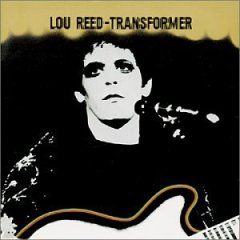
Transformer (1972)

"Perfect Day" Pretty weird for Lou Reed, but there are a lot of albums you can say that about. This features and was carried by his one hit, "Walk on the Wild Side," which sets the tone as Reed, with David Bowie parked at the board for inspiration, attempts a gorgeous pop-song extravaganza like Ziggy Stardust. But his way. Which means there's no shortage of drugs, drag queens, prostitutes, boys hitchhiking, etc. So is it all a big joke? You might think so. But even as the earnestness in "Vicious," "New York Telephone Conversation," or especially "Perfect Day" obviously plays for laughs, underneath it feels so genuinely sincere and heartfelt that sometimes in spite of yourself it's touching, like the effect of the final scene in City Lights. You know what they say about cynics and sentiment.

buy from CD Universe

Sunday, August 27, 2006

Low (1977)

"Sound and Vision" We all liked The Man Who Fell to Earth so much that David Bowie went ahead and used it for the covers of two albums that otherwise had little to do with the movie. This one was recorded in Berlin, with both Brian Eno and Iggy Pop -- Eno as co-auteur and Iggy as co-vocalist on one track. Of the three (or four?) collaborations between David Bowie and Brian Eno, Low was first and best. Ideas crackle and the band is tight, and if both sputter some on the second (vinyl LP) side, mostly instrumentals, it's more than redeemed by the seven gems on the first (vinyl LP) side. That would have made an A+++ EP in anyone's book. What's more, The Man Who Fell to Earth was a fine, fine film.

buy from CD Universe

Saturday, August 26, 2006

Aladdin Sane (1973)


"The Prettiest Star" By this time David Bowie was everywhere at once, his face the ubiquitous inscrutable mask we've come to expect. Signifying like a power station, but with his best profile to the light always. Mike Garson -- the piano player, who is insane -- is the key here. His crazy playing highlights and unifies and even blunts Bowie's already strained chronic bad habit of incoherent, usually very silly persona hopping. Somehow, the sheer explosive musicality of the sound, the songs and the playing, redeems all the nonsense. Here is a man who has painted a red and blue lightning bolt across his face and never cracks a smile. Imagine how hard we could be laughing. Remember W.A.S.P.?

buy from CD Universe

The Rise and Fall of Ziggy Stardust & the Spiders From Mars (1972)

"Moonage Daydream" The "narrative arc" tends to stay out of the way of the songcraft, which fact alone salvages the conceptness. Except for an oddly deformed version of "It Ain't Easy," which is little more than a throwaway plot point, this stuff is way beyond mere shtick. The chilling (if, comically, paging Jim Morrison) finish marks the high point in such stunning fashion that you're suddenly left thinking something important just happened. Going back then redeems itself. The short song titles start to make sense purely on their own terms: "Five Years." "Star." "Soul Love."

buy from CD Universe