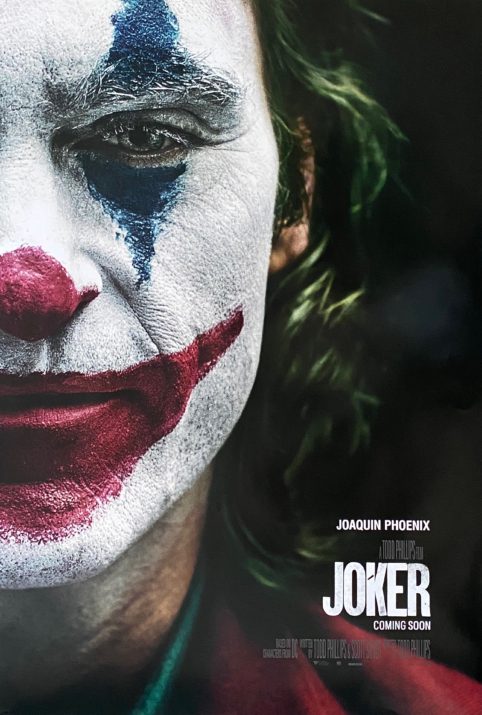
I skipped this originally for all the predictable reasons. It's a superhero movie, another more or less dark and gritty Batman movie—actually, better to call this one a Gotham City movie, as Bruce Wayne is barely in it. It is a "standalone," you see, an "Imaginary Story" in the grand old DC tradition. And it sets Joaquin Phoenix, noted gourmand of scenery, free to excessive displays of mental illness. These things did not appeal, and the reviews seemed mostly bad too. But I found one true heart beating for it on youtube (Sarah Hawkinson at the PossessedbyHorror channel, a regular stop) and decided to give it a try. I really don't know director Todd Phillips, who is famous for the Hangover movies and other gross-out teen comedies (Road Trip, Old School), none of which I've seen beyond The Hangover, on which I was meh. Immediately it made Joker look to me like a bid for being taken seriously in today's supersaturated comic book movie environment (compare Logan, which I haven't seen but has a similar marketing vibe). I basically enjoyed Joker, mostly for Phoenix's performance. One of the DC approaches to their movies seems to be "interpretive"—different players get their at-bats with the same character. Marvel does some of that but seems more to be more about buying up every player they can to be specific heroes. Anyway, how many Jokers do I know? Jack Nicholson, Cesar Romero. I have yet to see Jared Leto. Heath Ledger remains King Kong here, but I must say Phoenix makes a decent bid and comes in an easy second with his compulsive laughing disorder bit and a lot of quirks mainlined out of Travis Bickle. The main knock on this movie, and it's a fair one, is how completely derivative it is of Martin Scorsese movies, The King of Comedy most of all. Robert De Niro even kind of reprises Rupert Pupkin as a successful Johnny Carson. Taxi Driver is definitely in here as well. Joker also uses the narrative strategy of Frank Miller's original 1986 Dark Knight graphic novel, where the city is in crisis and self-serious urgent newscasts carry a lot of the exposition. Might as well say American Psycho (novel AND movie) gets its time in Joker too. Plus Juggalos, of course. These lifts arguably show a lot of studied good taste or acumen on the part of Phillips but not very much originality, and in many ways they fight with Phoenix's attempts to craft an original Joker. I get the feeling Phillips and Phoenix may not have been entirely working together. Phoenix carries the threat of Nicolas Cage levels of excess, but he is still an awesome talent and I think the script could have benefited from following his instincts more. But if Joker never entirely gets out of its own way it is never any less than entertaining either, with some neat twists and a lot of artful if extreme violence when the violence parts come. Phoenix makes the Joker haunting by the laughing disorder alone. The story delivers the rest, and it's not bad, if excessively familiar.
See DoestheDogDie report.
Showing posts with label Phillips. Show all posts
Monday, April 18, 2022
Thursday, November 02, 2017
"Home" (1978)
Story by Jayne Anne Phillips not available online.
Jayne Anne Phillips tells another story, which like "The Heavenly Animal" is also from her third collection of stories, Black Tickets, about fractured relationships in a modern media world. The first-person narrator, who goes unnamed, is 23 years old and recently returned home to live with her mother for an unspecified time. "I ran out of money and I wasn't in love, so I came home to my mother," is how she explains the situation. They watch the evening news most nights and worry about the general health of Walter Cronkite. Her mother is a professional, an "educational administrator," who works during the day and comes home and knits in front of the TV at night. They watch a lot of TV and attempt in various ways to connect. And they do connect, but they are also separated by the daughter's interest in exploring her sexuality. It looks—and not only to her mother—as if she is sinking into a life of serial monogamy, forever bewildered by an inability to forge something lasting. For the mother, it's alarming and depressing to see her daughter going that direction. The daughter, for her part, thinks her mother is just an old square. Her mother and father are divorced and there's some sense the father is dead now—a ne'er-do-well at best, as there is also a vague and ambiguous suggestion of sexual abuse. The narrative basically turns on the daughter inviting an old boyfriend for a visit. For the sake of the mother they stay in separate rooms, but they meet later for sex, which wakens and distresses the mother. The visiting ex-boyfriend is obviously a terrible relationship for the daughter—he's in another relationship and just taking advantage of an opportunity, though he's also sympathetic in other ways. I'm tempted to call the story dated because in many ways it could only take place in the '70s, but there's something broader and more universal about it than just that. It's a great example of a major direction for the short story after the '60s, with stories of broken families in American suburbs and a certain spiritual malaise (not actually Jimmy Carter's turn of phrase, but close enough), which lingered into the Reagan years and well beyond: divorce, TV, meaningless sex, temporary living conditions, and a grinding generation gap are typical elements. Phillips makes a pretty good job of it here, much better I think than "The Heavenly Animal."
The Vintage Book of Contemporary American Short Stories, ed. Tobias Wolff
Jayne Anne Phillips tells another story, which like "The Heavenly Animal" is also from her third collection of stories, Black Tickets, about fractured relationships in a modern media world. The first-person narrator, who goes unnamed, is 23 years old and recently returned home to live with her mother for an unspecified time. "I ran out of money and I wasn't in love, so I came home to my mother," is how she explains the situation. They watch the evening news most nights and worry about the general health of Walter Cronkite. Her mother is a professional, an "educational administrator," who works during the day and comes home and knits in front of the TV at night. They watch a lot of TV and attempt in various ways to connect. And they do connect, but they are also separated by the daughter's interest in exploring her sexuality. It looks—and not only to her mother—as if she is sinking into a life of serial monogamy, forever bewildered by an inability to forge something lasting. For the mother, it's alarming and depressing to see her daughter going that direction. The daughter, for her part, thinks her mother is just an old square. Her mother and father are divorced and there's some sense the father is dead now—a ne'er-do-well at best, as there is also a vague and ambiguous suggestion of sexual abuse. The narrative basically turns on the daughter inviting an old boyfriend for a visit. For the sake of the mother they stay in separate rooms, but they meet later for sex, which wakens and distresses the mother. The visiting ex-boyfriend is obviously a terrible relationship for the daughter—he's in another relationship and just taking advantage of an opportunity, though he's also sympathetic in other ways. I'm tempted to call the story dated because in many ways it could only take place in the '70s, but there's something broader and more universal about it than just that. It's a great example of a major direction for the short story after the '60s, with stories of broken families in American suburbs and a certain spiritual malaise (not actually Jimmy Carter's turn of phrase, but close enough), which lingered into the Reagan years and well beyond: divorce, TV, meaningless sex, temporary living conditions, and a grinding generation gap are typical elements. Phillips makes a pretty good job of it here, much better I think than "The Heavenly Animal."
The Vintage Book of Contemporary American Short Stories, ed. Tobias Wolff
Sunday, October 29, 2017
"The Heavenly Animal" (1975)
Story by Jayne Anne Phillips not available online.
This story by Jayne Anne Phillips has a lot of good ideas but never quite executes on them. The premise is so familiar to its times as to nearly verge on cliché, but I don't think that's the problem exactly. It's a baby boomer generation gap story about a young woman in her mid-20s, Jancy, whose parents have divorced acrimoniously and now she is stuck with the shattered pieces and ongoing fallout, still living at home with her mother. Her father refuses to visit or "even step on the grass" of the home he once shared with his ex-wife and Jancy. He lives only 10 blocks away and honks when he drives by and sees Jancy's car there. He expresses his love for her by making sure her car is maintained. Meanwhile, Jancy is footloose and often troubled by tormented relationships. This is good stuff, but it doesn't feel like Phillips gets very far into her material. She has a good sense for the way these people live their lives, but falls short a little in the expression. It somehow feels like she is telling more than showing, even as the story is full of short paragraphs and intriguing stylistic eccentricities such as no quotation marks for dialogue. Maybe this is ultimately more on the order of pioneering work, opening up a rich vein that others would mine with more success. Mary Gaitskill comes to mind. I like this kind of material actually a lot—family estrangements. I just expect them to be a little more heartrending than I found this story. It is built out of powerful emotional material, which is strangely distanced and inert. It labors for a big ending with an auto accident involving a deer, but feels too thought through and abstracted. I didn't like anyone here that much. The father is bumbling and means well but he's also an old-fashioned bigot. Jancy is too skittish and confused to trust, but it takes a bit to figure that out, with the result I felt a little tricked. I've already forgotten any impression of the mother. The father is extreme about rejecting his ex-wife even as he is slipping into unattractive cheap and easy ways to live, which make him look like he doesn't really care much about living at all. The whole car thing is where the story felt most stale to me, and it is fundamental to multiple strains in it. I guess that means I have to call it flawed. But I like the direction it's going.
American Short Story Masterpieces, ed. Raymond Carver and Tom Jenks
This story by Jayne Anne Phillips has a lot of good ideas but never quite executes on them. The premise is so familiar to its times as to nearly verge on cliché, but I don't think that's the problem exactly. It's a baby boomer generation gap story about a young woman in her mid-20s, Jancy, whose parents have divorced acrimoniously and now she is stuck with the shattered pieces and ongoing fallout, still living at home with her mother. Her father refuses to visit or "even step on the grass" of the home he once shared with his ex-wife and Jancy. He lives only 10 blocks away and honks when he drives by and sees Jancy's car there. He expresses his love for her by making sure her car is maintained. Meanwhile, Jancy is footloose and often troubled by tormented relationships. This is good stuff, but it doesn't feel like Phillips gets very far into her material. She has a good sense for the way these people live their lives, but falls short a little in the expression. It somehow feels like she is telling more than showing, even as the story is full of short paragraphs and intriguing stylistic eccentricities such as no quotation marks for dialogue. Maybe this is ultimately more on the order of pioneering work, opening up a rich vein that others would mine with more success. Mary Gaitskill comes to mind. I like this kind of material actually a lot—family estrangements. I just expect them to be a little more heartrending than I found this story. It is built out of powerful emotional material, which is strangely distanced and inert. It labors for a big ending with an auto accident involving a deer, but feels too thought through and abstracted. I didn't like anyone here that much. The father is bumbling and means well but he's also an old-fashioned bigot. Jancy is too skittish and confused to trust, but it takes a bit to figure that out, with the result I felt a little tricked. I've already forgotten any impression of the mother. The father is extreme about rejecting his ex-wife even as he is slipping into unattractive cheap and easy ways to live, which make him look like he doesn't really care much about living at all. The whole car thing is where the story felt most stale to me, and it is fundamental to multiple strains in it. I guess that means I have to call it flawed. But I like the direction it's going.
American Short Story Masterpieces, ed. Raymond Carver and Tom Jenks
Saturday, January 28, 2017
Silver Bullets (2015)
My association with the Chills, a New Zealand band headed by Martin Phillips since the '80s, is mainly limited to two albums from the early '90s, Submarine Bells and Soft Bomb (one wonders what the recurring SB initials are about ... other Chills releases include Sunburnt, Somewhere Beautiful, Sketch Book, Secret Box, and Stand By). Submarine Bells and Soft Bomb are not only great albums but also filled with luminous pop songs of such certain purity they can be broken off, in mix tapes and such, and lived with individually, for years in some cases (their greatest hit by my lights is still the deeply insular "Song for Randy Newman, Etc.," a kind of theme song for living). Phillips is the only constant across the years of the Chills and he has always been the chief songwriter. Sometimes I suspect the band name has something to do with the similarity with his last name. All songs on Silver Bullets are by him, as usual, and along with many other of these recent surprise returns (David Bowie and the Sonics come to mind right away, and even the Rolling Stones might be getting in on it now), the consistent high quality is the most pleasant part of the surprise. Phillips was still up to moderate rock 'n' roll heroics in Submarine Bells—he's the guitar player, after all—but he was already tending toward primacies of mood and atmosphere. Soft Bomb was more of that and Silver Bullets, even across a gap of over 20 years, is even more. The songs on Silver Bullets shimmer and glow, throwing up fragments of lyrics that clarify through repetition, yet remain stubbornly enigmatic: "warm waves," "silver bullets," "America says hello," "when the poor can reach the moon," "aurora corona," "tomboy," "molten gold." The song about the poor and the moon runs over eight minutes, which anyone would have to call long, with a kind of prog structure that shifts from theme to theme. Most of the songs are a little long (or short) for pure pop music, in other words, but then that's not exactly what Phillips is doing any more. This is probably for fans only, but all fans will want to hear it.
Wednesday, July 18, 2007
Submarine Bells (1990)
My brief and intense infatuation with this glittering collection of Chills songs coincided with the onset of the first Iraq War and also, as it happens, initiated me to the CD format, which until then I had resisted. I had to listen to this one every day for several weeks; that's what the pleasure brought me to. From North America, New Zealand is so far away that it might as well be another fantasy planet, a place where all problems are solved and joy reigns supreme. Actually, I know better than that (as does principal songwriter Martin Phillips). But the brilliantly fresh sound of this album and its pop concoctions can often seem undimmed by the events of human history, large and small – even when the stories they contain belie at least the latter. The melancholy remains resolutely sweet.
Thursday, April 19, 2007
The Sun Sessions (1954-1955)
"That's All Right" The most important album of Elvis Presley's career, not to mention arguably in rock 'n' roll history, is actually a pastiche of Sun singles and outtakes first put together in the mid-'70s. Since then, various takes have gone in and come out, the cover has changed once or twice or more, and it's been remastered nearly as often, following the whims of the times. But oh who cares? In the end, all definitions fade and are inadequate to the material here. Recorded before Elvis was even 21, backed by a couple of talented good ol' boys on guitar and bass, drawing on resources imported direct from the primal human experience, I can't imagine what these songs must have sounded like to the people who made regional hits of them in the mid-'50s U.S. South. It's fresh, it's catchy, sure, all of that, but it's always tempting to reiterate the claims about it that have become cliches: "big bang of rock 'n' roll," etc. But listen, these three guys and particularly the singer (with Sun's Sam Phillips at the board) go about their business with astonishing efficiency, neatly stitching together fragments of country and blues in a way no one quite had before, and somehow they changed everything.buy from Amazon
Subscribe to:
Posts (Atom)


